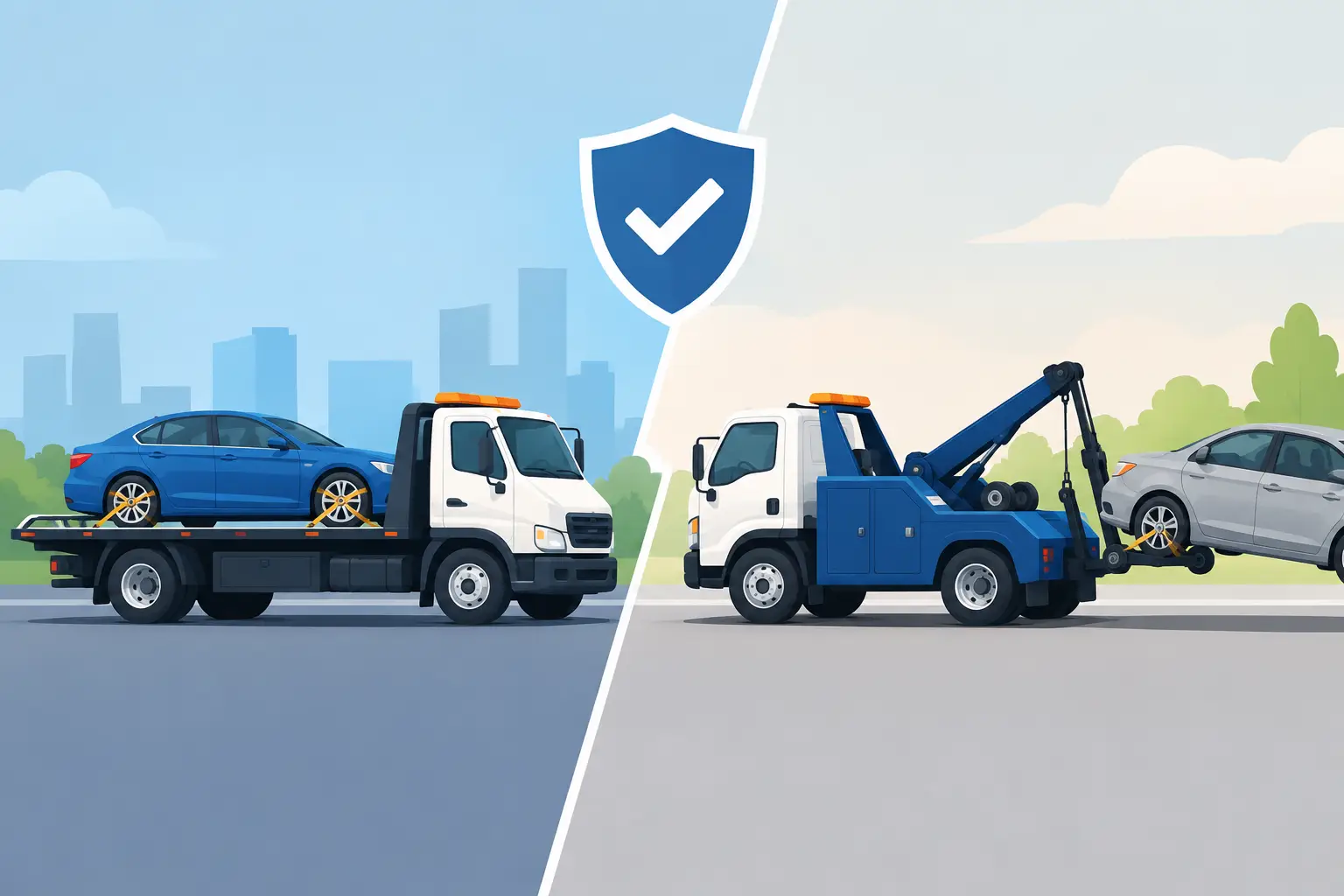
A recovery vehicle arriving at the roadside is a reassuring sight, but the method used matters. In the decision between flatbed recovery vs wheel lift, the right option depends on the vehicle’s condition, drivetrain, clearance, location and onward journey. For a prestige car, an accident-damaged vehicle or anything with an unknown fault, that choice can protect the vehicle from further damage.
A wheel lift can be an efficient solution for the right vehicle and short recovery. A flatbed provides full support and keeps all four wheels off the road. Neither is automatically the answer to every call-out. The priority is to assess the vehicle properly, use suitable equipment and move it in a controlled way.
What is flatbed recovery?
Flatbed recovery uses a lorry with a level loading bed that tilts or slides to create a ramp. The vehicle is winched or driven onto the bed, then secured at multiple points for transport. Once loaded, none of the vehicle’s tyres remain in contact with the road.
This is generally the preferred method when a vehicle cannot be driven, has suffered accident damage or needs careful transport over a longer distance. It also gives the recovery operator more control during loading, particularly where steering, suspension, wheels or drivetrain components may be compromised.
For prestige, classic and low-clearance vehicles, a flatbed allows the loading angle and winching process to be managed carefully. Protective measures can be used to reduce the risk of bumper, splitter, sill or wheel damage. That matters when a vehicle is valuable not only financially, but also personally.
When a flatbed is usually the best choice
Flatbed recovery is often appropriate after a collision, when the vehicle has a puncture alongside other faults, or where there is visible damage to the underbody, suspension or wheels. It is also the safer option when a vehicle is automatic, electric, four-wheel drive or fitted with a drivetrain that should not be towed with one axle on the road.
It is particularly useful for vehicles that have lost a wheel, cannot roll freely, have locked brakes or cannot be placed in neutral. If a car is being moved from a dealership, garage, secure storage location or private collection, flatbed transport also provides a more controlled journey than towing it behind a recovery vehicle.
Longer-distance transport is another strong case for a flatbed. Removing tyre contact with the road avoids unnecessary mileage, tyre wear and the mechanical stress associated with towing. For a planned UK or European movement, that added protection is usually worth it.
What is wheel lift recovery?
A wheel lift is a hydraulic yoke fitted to a recovery vehicle. It lifts either the front or rear wheels of the vehicle clear of the ground, while the opposite pair of wheels stays on the road. The vehicle is then towed behind the recovery lorry.
Modern wheel lifts are much more controlled than older-style hook towing, which could place pressure on bumpers or bodywork. Used correctly, a wheel lift can be a practical and efficient recovery method, especially in confined locations where positioning a flatbed is difficult.
A wheel lift may be suitable for a short-distance recovery involving a two-wheel-drive vehicle that can roll freely and has no accident damage affecting the wheels, steering or suspension. It can also be useful when roadside space is limited, such as a narrow street, busy car park or restricted access point.
The limitations of a wheel lift
The key limitation is that two wheels remain on the road. That creates potential issues for certain drivetrains and vehicle conditions. Towing an all-wheel-drive or four-wheel-drive vehicle with only one axle raised can cause serious transmission damage unless the manufacturer specifically permits it or appropriate dollies are used.
Many automatic vehicles also have restrictions on being towed with their driven wheels on the road. Electric and hybrid vehicles may have manufacturer-specific recovery procedures due to their motors, transmission systems and high-voltage components. A recovery operator should never assume that one method suits every make or model.
Wheel lift recovery may also be unsuitable for low vehicles, vehicles with damaged suspension, steering faults, seized brakes or a compromised axle. If the vehicle has been involved in an accident, moving it with two wheels on the ground can worsen existing damage or create a safety risk during transport.
Flatbed recovery vs wheel lift: the practical differences
The main difference is simple: a flatbed carries the whole vehicle, while a wheel lift tows it with one axle raised. That difference affects safety, suitability and the level of protection available during recovery.
Flatbed recovery offers greater versatility. It can accommodate non-runners, accident-damaged cars and vehicles with drivetrain restrictions, provided they can be safely loaded. It is also better suited to high-value vehicles where avoiding road contact, debris and added mileage is a priority.
Wheel lift recovery can be faster to deploy in some restricted spaces and may be appropriate for straightforward, short-distance moves. However, it requires greater certainty about the vehicle’s condition and towing requirements. If there is doubt over the drivetrain, transmission, steering or accident damage, a flatbed is normally the more cautious choice.
Cost can vary too. A wheel lift may involve less loading time for a simple local recovery, while a flatbed can require more space and preparation. But choosing a cheaper method that is unsuitable for the vehicle can become expensive quickly. The recovery method should be based on risk, not just the immediate price.
Which recovery method is best for prestige vehicles?
For most prestige vehicles, flatbed recovery is the preferred option. High-performance cars often sit lower to the ground, use sophisticated suspension systems and may have drivetrain layouts that make conventional towing inappropriate. Even a minor loading error can damage a front splitter, diffuser, alloy wheel or undertray.
A proper flatbed recovery gives the operator the opportunity to inspect the loading route, manage the ramp angle and use a winch where driving the vehicle onto the bed would be unsafe. The vehicle can then be secured for stable transport without relying on its drivetrain to turn during the journey.
That does not mean a wheel lift is never possible for a prestige car. A suitable two-wheel-drive vehicle with no damage may be moved this way in a specific roadside situation. The decision should be made only after checking the vehicle’s recovery guidance, condition and the practical risks at the scene.
Questions a recovery operator should ask
A reliable recovery starts before the vehicle is loaded. The operator needs to know whether the car has been in an accident, whether it will start, whether the wheels turn, whether the brakes are released and whether the steering works. The make, model, drivetrain and ground clearance are equally relevant.
It also helps to establish where the vehicle is located. A car stranded on a motorway hard shoulder, a tight residential road, a multi-storey car park or a rural lane may require different equipment and a different loading plan. The intended destination matters too. A short move to a local garage is not the same as specialist transport across the country or into Europe.
Owners can help by explaining any known modifications, such as lowered suspension, aftermarket bodywork, wide wheels or air suspension. If the vehicle has a keyless system, electronic parking brake or transport mode, that information can prevent delays and reduce handling risk.
Do not let urgency override the right method
Breakdowns and accidents are stressful, especially when the vehicle is blocking traffic or stranded somewhere unsafe. It is understandable to want it moved immediately. Speed matters, but so does selecting a method that will not cause a second problem.
If the vehicle is damaged, low, four-wheel drive, electric, automatic or simply too valuable to take chances with, request a flatbed recovery. If it is a straightforward local recovery and the vehicle is suitable for towing, a wheel lift may be an efficient option. The right choice comes from a proper assessment, not a one-size-fits-all approach.
MHJ Prestige Transport provides 24/7 recovery and specialist vehicle transport with the equipment and handling care required for urgent roadside situations and planned movements. When you call for help, share as much detail about the vehicle and its condition as possible. That gives the recovery team the best chance of sending the right vehicle first time and getting your car moved safely.